| Availability: | |
|---|---|
| Quantity: | |
Advanced Fixed-Film Biofilm Process
At the core of this system is a highly efficient Biofilm Package Sewage Treatment Plant design. Wastewater flows through specialized media that hosts a protected, dense layer of microorganisms.,Offering superior resistance to toxic shocks, temperature fluctuations, and varying loadings, ensuring uninterrupted compliance.
Sequential Anaerobic-Anoxic-Oxic Environments
The plant is engineered to intelligently create sequential Anaerobic, Anoxic, and Oxic conditions within a single, integrated reactor. The result is a comprehensive purification process that meets stringent municipal discharge or reuse standards.
Scalable & Flexible Modular Design
The Modular Municipal Package Sewage Treatment Plant is built around a scalable, containerized concept. Treatment capacity can be easily increased by adding standardized modules, allowing for phased investment that matches community growth.
Key Advantages for Community-Wide Applications
Rapid Deployment & Minimal Civil Works: Pre-fabricated Modular units arrive on-site ready for swift installation, significantly cutting down project timelines and construction costs compared to traditional concrete plants.
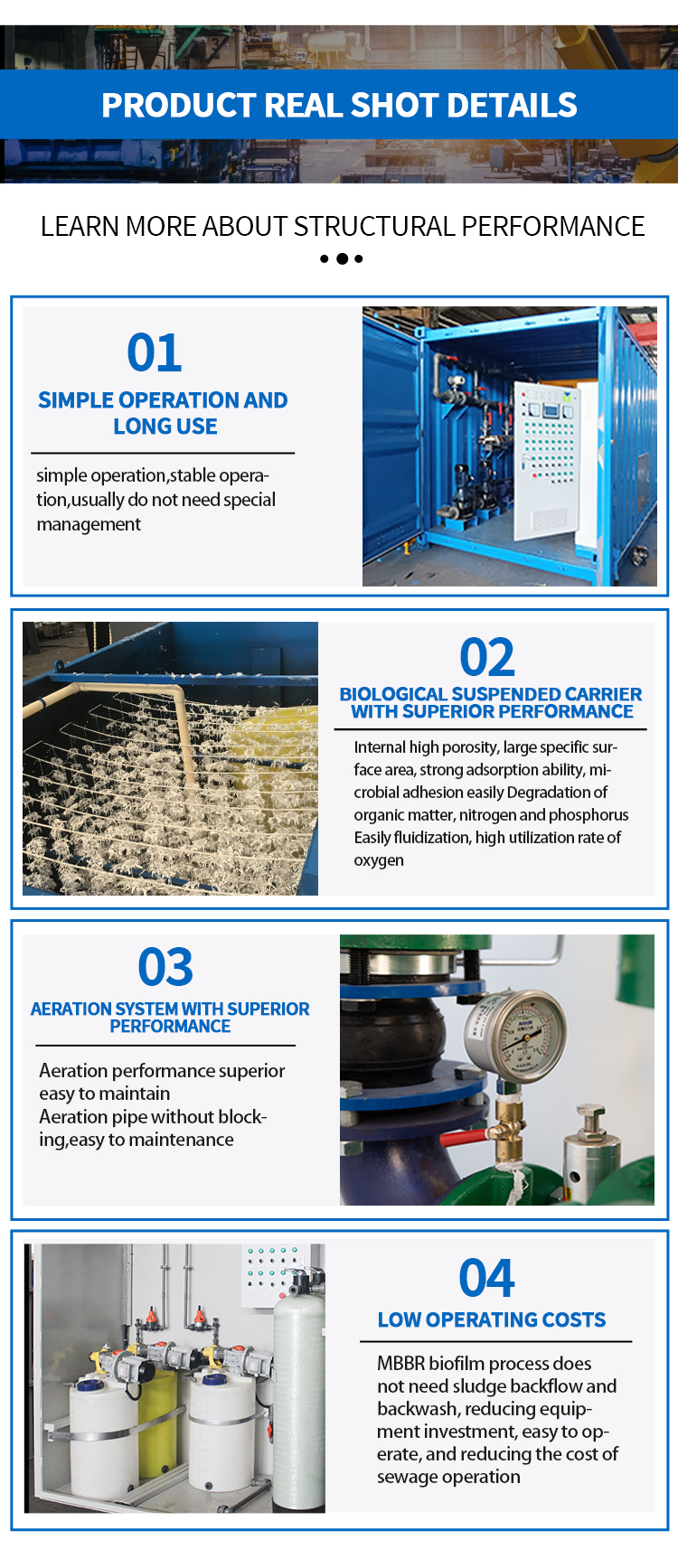
Low Maintenance & Operational Simplicity: The protected Biofilm requires less operator intervention and does not need sludge recirculation, reducing energy consumption and the need for highly skilled personnel—a critical advantage in remote or resource-limited areas.
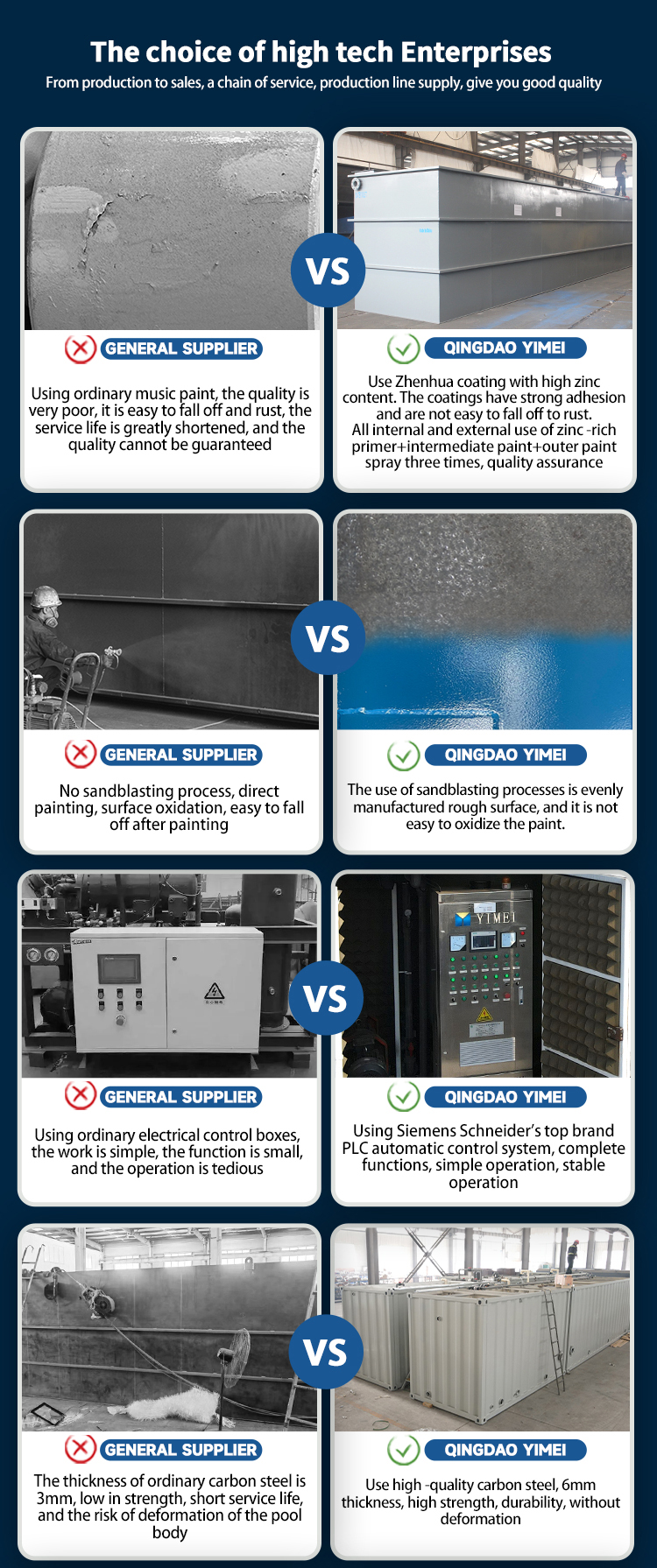
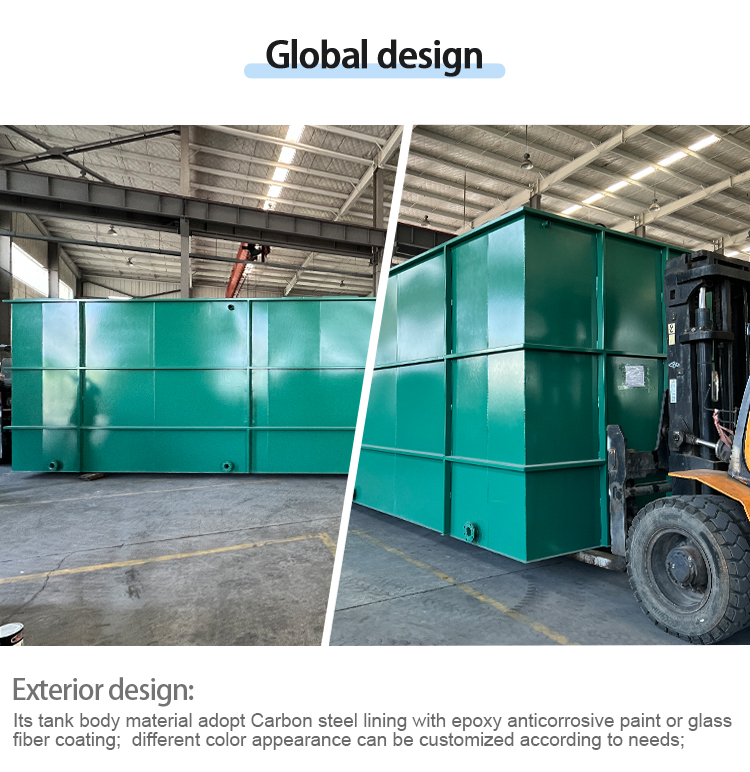
Durable for Harsh Climates: Constructed with corrosion-resistant materials, the plant is built to withstand high humidity, coastal air, and extreme weather, ensuring decades of reliable service.
Odor-Free & Community-Friendly: The enclosed Modular design and aerobic process effectively contain and treat odors, making the plant a neighbor-friendly solution suitable for installation near residential areas.
Product Parameters
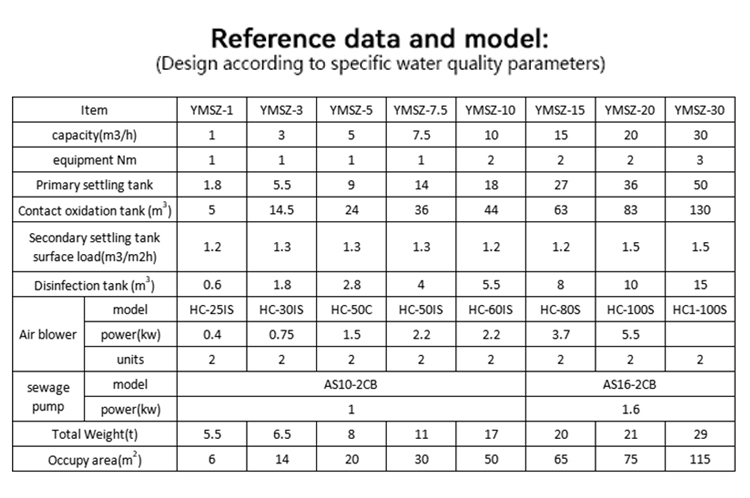
| Item | YMSZ-1 | YMSZ-3 | YMSZ-5 | YMSZ-7.5 | YMSZ-10 | YMSZ-15 | YMSZ-20 | YMSZ-30 | |
| capacity(m3/h) | 1 | 3 | 5 | 7.5 | 10 | 15 | 20 | 30 | |
| equipment Nm | 1 | 1 | 1 | 1 | 2 | 2 | 2 | 3 | |
| Primary settling tank | 1.8 | 5.5 | 9 | 14 | 18 | 27 | 36 | 50 | |
| Contact oxidation tank(m³) | 5 | 14.5 | 24 | 36 | 44 | 63 | 83 | 130 | |
| Secondary settling tank surface load(m3/m2h) | 1.2 | 1.3 | 1.3 | 1.3 | 1.2 | 1.2 | 1.5 | 1.5 | |
| Disinfection tank(m³) | 0.6 | 1.8 | 2.8 | 4 | 5.5 | 8 | 10 | 15 | |
| Air blower | model | HC-25IS | HC-30IS | HC-50C | HC-50IS | HC-60IS | HC-80S | HC-100S | HC1-100S |
| power(kw) | 0.4 | 0.75 | 1.5 | 2.2 | 2.2 | 3.7 | 5.5 | ||
| units | 2 | 2 | 2 | 2 | 2 | 2 | 2 | 2 | |
sewage pump | model | AS10-2CB | AS16-2CB | ||||||
| power(kw) | 1 | 1.6 | |||||||
| Total Weight(t) | 5.5 | 6.5 | 8 | 11 | 17 | 20 | 21 | 29 | |
| Occupy area(m²) | 6 | 14 | 20 | 30 | 50 | 65 | 75 | 115 | |
FAQ
Q: What is the required installation footprint and setup time?
A: As a packaged plant, it is highly compact. Site preparation primarily involves a level concrete base and connection points. The pre-assembled nature allows for commissioning within weeks, not months.
Q: How skilled does the operating staff need to be?
A: The system is designed for ease of use. We provide comprehensive training and a detailed manual. The automated control system handles most process adjustments, requiring only routine monitoring from the operator.
Q: Can it handle fluctuating wastewater flow and composition, common in industrial settings?
A: Yes. The hybrid biological process is renowned for its stability and resilience to shock loads, making our Industry Wastewater Packaged Sewage Treatment Plant ideal for variable industrial discharges.
Q: What are the advantages of the Stainless Steel MBR model?
A: The Stainless Steel MBR Packaged Sewage Treatment Plant offers the highest effluent quality via membrane filtration, a smaller footprint, and maximum durability. It is the premium choice for strict discharge standards and corrosive environments
Q: How do you support clients in remote locations?
A: We offer remote troubleshooting support via video call and a network of local partners. The design prioritizes ease of maintenance, and we ensure critical spare parts are readily available.


Product Introduction |
The Customized High-Performance Package Sewage Treatment Plant is a modular wastewater treatment system developed for community-scale sewage management, public infrastructure, and decentralized treatment projects. Its design combines fixed-film biofilm treatment, sequential anaerobic-anoxic-oxic biological environments, prefabricated construction, and scalable capacity options.
The biological treatment section uses specialized carrier media that provides a protected surface for microorganisms to attach and develop into a dense biofilm. Retaining microorganisms on the media helps maintain an active biological population within the treatment system and improves resistance to changing wastewater conditions, including variations in pollutant loading and temperature.
The treatment process is arranged around sequential anaerobic, anoxic, and oxic environments. These different biological conditions allow wastewater to pass through a more comprehensive treatment sequence rather than relying on a single aerobic treatment stage. The configuration is designed for municipal sewage treatment and reuse projects where removal of organic pollutants and nutrients must be considered together.
A major advantage of this model is its customized and modular configuration. The plant can be selected from the YMSZ series according to treatment flow, while additional standardized modules can be incorporated when a community or infrastructure project requires more capacity. This allows treatment investment to follow actual wastewater demand instead of requiring the final maximum plant size during the first project phase.
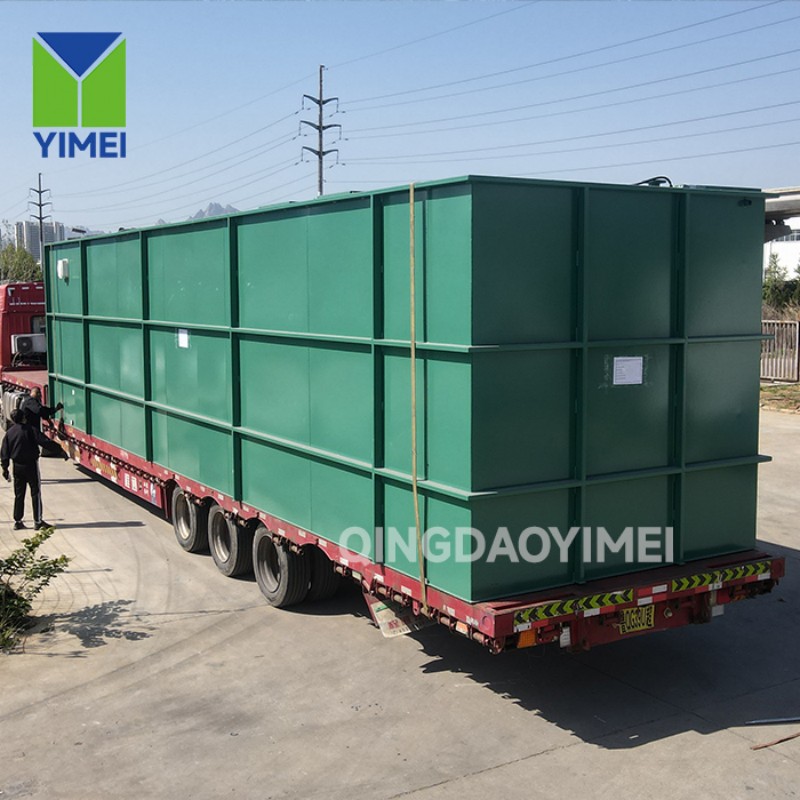
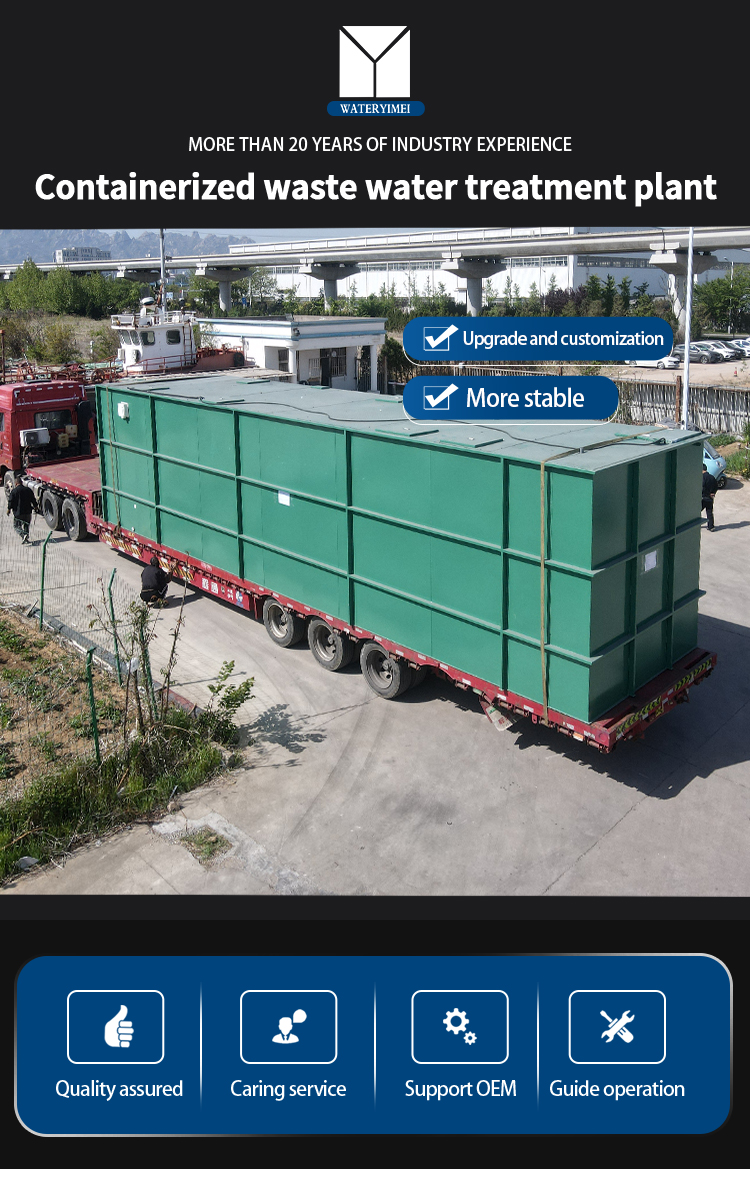
The prefabricated treatment units arrive at the project site largely assembled, helping reduce extensive civil construction and field fabrication. This is particularly useful for communities, remote areas, coastal sites, and infrastructure projects where conventional concrete treatment plants may require longer construction periods and more specialized local resources.
The system is also designed around simplified operation. The protected biofilm process requires limited operator intervention, while the product page states that sludge recirculation is not required. Corrosion-resistant construction, enclosed treatment modules, and an aerobic treatment configuration further support operation in demanding climates and near residential areas.
With YMSZ capacities ranging from 1 to 30 m³/h, the plant provides a flexible treatment platform for growing communities and public wastewater infrastructure projects requiring compact construction and future expansion capability.
Product Parameters
Item | YMSZ-1 | YMSZ-3 | YMSZ-5 | YMSZ-7.5 | YMSZ-10 | YMSZ-15 | YMSZ-20 | YMSZ-30 | |
capacity(m3/h) | 1 | 3 | 5 | 7.5 | 10 | 15 | 20 | 30 | |
equipment Nm | 1 | 1 | 1 | 1 | 2 | 2 | 2 | 3 | |
Primary settling tank | 1.8 | 5.5 | 9 | 14 | 18 | 27 | 36 | 50 | |
Contact oxidation tank(m³) | 5 | 14.5 | 24 | 36 | 44 | 63 | 83 | 130 | |
Secondary settling tank | 1.2 | 1.3 | 1.3 | 1.3 | 1.2 | 1.2 | 1.5 | 1.5 | |
Disinfection tank(m³) | 0.6 | 1.8 | 2.8 | 4 | 5.5 | 8 | 10 | 15 | |
Air blower | model | HC-25IS | HC-30IS | HC-50C | HC-50IS | HC-60IS | HC-80S | HC-100S | HC1-100S |
power(kw) | 0.4 | 0.75 | 1.5 | 2.2 | 2.2 | 3.7 | 5.5 | ||
units | 2 | 2 | 2 | 2 | 2 | 2 | 2 | 2 | |
| model | AS10-2CB | AS16-2CB | ||||||
power(kw) | 1 | 1.6 | |||||||
Total Weight(t) | 5.5 | 6.5 | 8 | 11 | 17 | 20 | 21 | 29 | |
Occupy area(m²) | 6 | 14 | 20 | 30 | 50 | 65 | 75 | 115 | |
Features & Advantages |
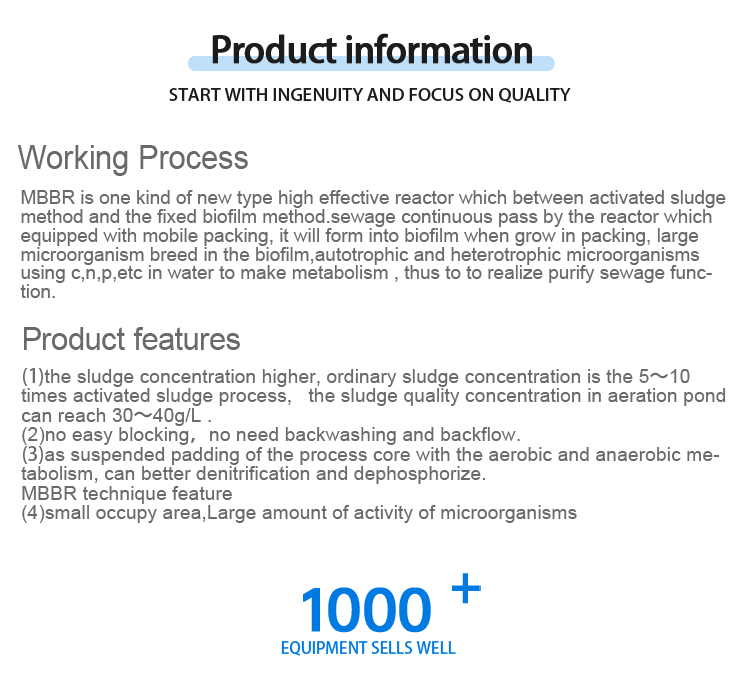
The core biological process uses fixed-film biofilm technology.
Specialized media is installed inside the treatment system to provide a large protected surface where microorganisms can attach and grow.
Instead of maintaining the entire biological population only as suspended solids in wastewater, a substantial portion of the microbial community remains attached to the carrier surface.
This helps retain active microorganisms inside the biological reactor and creates a stable treatment environment.
The dense biofilm is designed to support continuous biological degradation of wastewater pollutants while remaining protected against changes in influent conditions.
Community and decentralized wastewater flows can vary according to population, daily activity, seasonal changes, and connected facilities.
The product page specifically identifies resistance to toxic shocks, temperature fluctuations, and varying wastewater loads as characteristics of the fixed-film process.
The protected biological media helps preserve the microbial population when influent conditions change.
This is important for decentralized treatment installations where wastewater loading may be less stable than at a large centralized municipal sewage treatment plant.
The treatment system is engineered to create sequential anaerobic, anoxic, and oxic environments within an integrated reactor.
Each biological environment provides different conditions for wastewater treatment.
The anaerobic section operates without dissolved oxygen, while the anoxic zone provides conditions suitable for biological processes requiring limited oxygen. Wastewater subsequently enters the oxic section, where aeration supports aerobic microbial activity.
Combining these stages creates a more comprehensive biological treatment sequence than using a single aerobic zone alone.
The process is intended to support municipal wastewater purification where both organic pollutant removal and nutrient control are required.
The system is positioned as a customized package sewage treatment plant rather than a single fixed configuration for every project.
Community wastewater projects can differ substantially in treatment flow, available installation area, development stage, and required future capacity.
The modular concept allows the treatment configuration to be matched more closely to the actual project.
Different YMSZ models can be selected according to wastewater flow, and multiple equipment modules are used as treatment capacity increases.
This makes the product suitable for projects that require a treatment system adapted to site conditions instead of a completely standardized one-size-fits-all solution.
The treatment plant uses a scalable modular construction concept.
Standardized treatment units can be combined to increase total capacity as wastewater demand grows.
This provides an advantage for communities and public infrastructure projects developed in several stages.
Instead of constructing a large final-capacity treatment plant before the wastewater flow exists, the project can begin with a smaller treatment configuration and add modules later.
This phased approach helps treatment infrastructure develop together with population growth and actual wastewater generation.
The treatment modules are prefabricated before arriving at the installation site.
Pre-assembled equipment reduces the amount of fabrication required during project construction.
Compared with conventional wastewater treatment plants based largely on reinforced concrete tanks and extensive field assembly, the packaged configuration can reduce the amount of civil construction associated with installation.
Site preparation primarily focuses on preparing a suitable level concrete base, utility connections, wastewater inlet and outlet connections, and other required interfaces.
The product page identifies rapid deployment and reduced civil works as major advantages of the modular system.
The fixed-film treatment process is designed to reduce routine operator intervention.
Because microorganisms remain attached to protected carrier media, biological operation does not depend entirely on maintaining suspended biomass through continuous manual process adjustment.
The product page also states that the system does not require sludge recirculation.
This simplifies the operating arrangement compared with biological treatment systems that rely heavily on a dedicated return-sludge loop.
For remote communities and locations with limited access to highly specialized wastewater operators, simplified process management can be an important project consideration.
Daily operation is designed around routine monitoring rather than constant manual adjustment.
The product FAQ states that the automated control system handles most process adjustments.
Operators can therefore concentrate on regular checks of equipment condition, blowers, pumps, treatment sections, sludge handling, and other routine maintenance tasks.
Training and operating documentation are also identified as part of the system support.
This operating concept makes the package plant suitable for communities and infrastructure projects where a large permanent wastewater operations team may not be available.
The treatment plant is designed for operation in demanding outdoor and wastewater environments.
The product page specifically identifies corrosion-resistant construction for areas exposed to high humidity, coastal air, and extreme weather.
This is particularly relevant for municipal infrastructure installed in coastal communities, islands, humid climates, and outdoor locations where equipment remains exposed to environmental conditions for long periods.
Material durability therefore forms part of the plant's overall community and infrastructure positioning.
Wastewater treatment equipment installed near residential communities must also consider its effect on the surrounding environment.
The plant uses an enclosed modular configuration intended to contain treatment processes within the equipment structure.
The page specifically identifies odor control as an advantage of the enclosed design combined with the aerobic biological process.
This makes the system more suitable for installation close to residential areas than an open treatment arrangement where process tanks and wastewater surfaces may be more exposed.
The YMSZ series includes eight listed treatment capacities:
YMSZ-1: 1 m³/h
YMSZ-3: 3 m³/h
YMSZ-5: 5 m³/h
YMSZ-7.5: 7.5 m³/h
YMSZ-10: 10 m³/h
YMSZ-15: 15 m³/h
YMSZ-20: 20 m³/h
YMSZ-30: 30 m³/h
Smaller models from YMSZ-1 through YMSZ-7.5 are listed with one equipment unit.
YMSZ-10, YMSZ-15, and YMSZ-20 use two equipment units, while YMSZ-30 uses three.
The modular progression allows treatment capacity and equipment quantity to increase together as project flow requirements become larger.
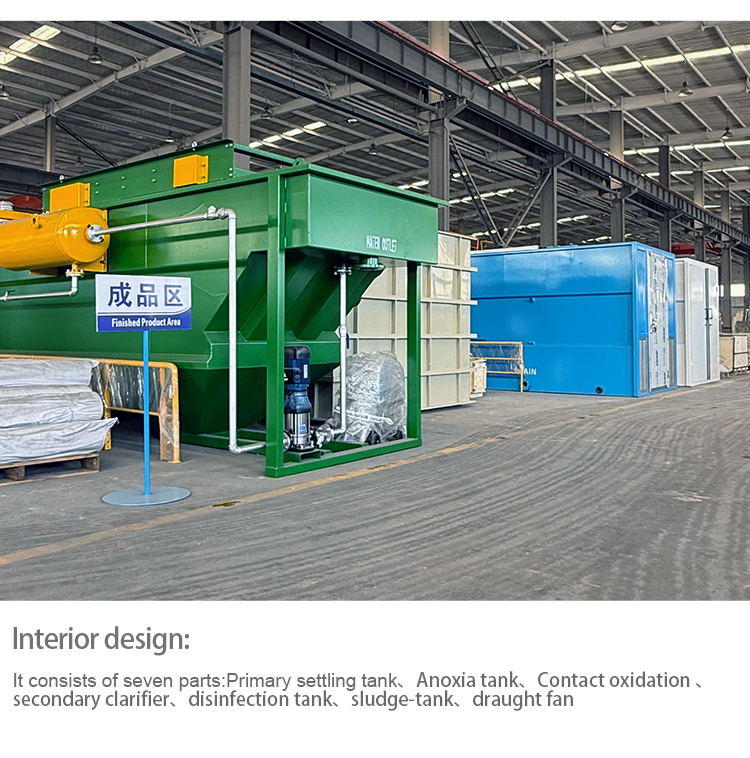
The published YMSZ configuration includes several wastewater treatment sections.
The primary settling tank increases from 1.8 on YMSZ-1 to 50 on YMSZ-30.
The contact oxidation tank ranges from 5 m³ on the smallest model to 130 m³ on the largest model.
The secondary settling tank surface load is listed between 1.2 and 1.5 m³/m²·h across the series.
Disinfection tank volume increases from 0.6 m³ to 15 m³ according to model capacity.
The system also includes two air blower units across the listed range together with sewage pumps.
These integrated components allow the packaged system to provide multiple wastewater treatment stages inside a coordinated plant configuration.
The occupied area changes according to model capacity:
YMSZ-1: 6 m²
YMSZ-3: 14 m²
YMSZ-5: 20 m²
YMSZ-7.5: 30 m²
YMSZ-10: 50 m²
YMSZ-15: 65 m²
YMSZ-20: 75 m²
YMSZ-30: 115 m²
This gives project planners a direct reference when considering both wastewater capacity and available installation space.
Applications |
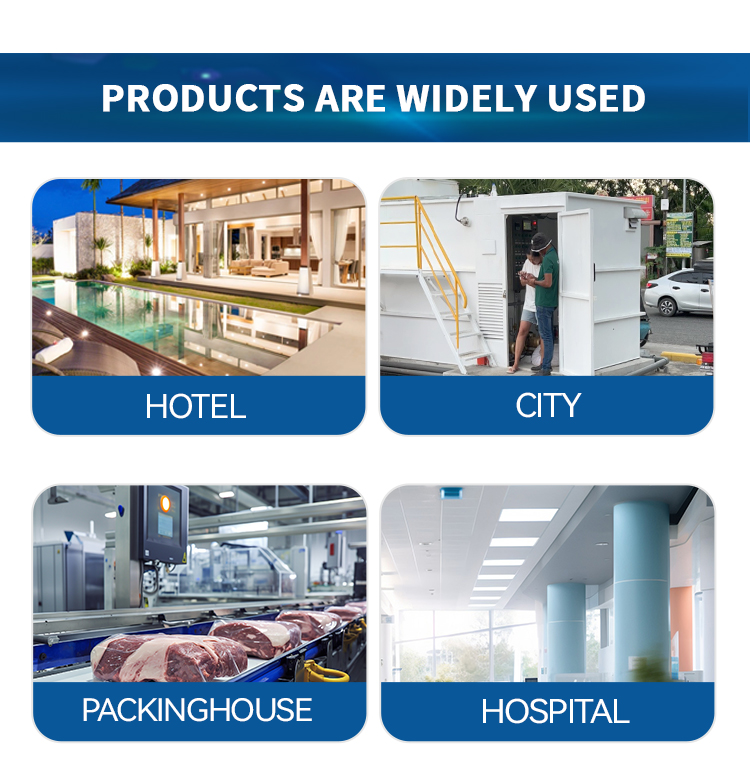
The treatment plant is particularly suited to communities where population and wastewater generation are expected to increase over time.
A new residential development may begin with only part of its planned population, while additional housing is completed in later phases.
The modular treatment system allows the initial wastewater plant to be sized according to the current load.
Additional modules can then be incorporated as more residents connect to the system.
This avoids installing the entire future treatment capacity before it is actually needed and supports phased infrastructure investment.
The system can serve as a centralized treatment facility for small and medium-sized communities that do not have practical access to a large municipal sewage treatment plant.
Domestic wastewater from multiple buildings can be collected and treated through one packaged biological system.
The fixed-film process provides biological pollutant removal, while the integrated treatment configuration includes settling and disinfection stages.
The enclosed plant structure also makes the equipment more appropriate for locations close to residential areas.
Public infrastructure developments often require wastewater treatment to be installed alongside new roads, housing, public buildings, and utility systems.
A prefabricated package plant can reduce the amount of specialized wastewater construction required at the site.
Because the major treatment sections are already integrated into modular equipment, installation can be coordinated with the broader infrastructure project.
The scalable configuration is also valuable when infrastructure is constructed in stages.
Remote locations can create challenges for conventional wastewater treatment construction and operation.
Large reinforced-concrete treatment plants may require extensive materials, skilled construction teams, and lengthy on-site work.
The prefabricated modular system reduces these requirements by completing more of the equipment assembly before shipment.
Simplified biological operation is also important in remote locations where highly specialized wastewater operators may not be continuously available.
The fixed-film process, absence of required sludge recirculation, and automated controls are intended to reduce routine operating complexity.
The package plant can also be used where local technical and construction resources are limited.
A treatment system requiring constant manual process adjustment or complex sludge-return management can create difficulties in these locations.
The protected biofilm process is designed to require less operator intervention, while the automated control system handles many routine process adjustments.
This allows local personnel to focus primarily on routine inspection, maintenance, and operating checks.
The page identifies corrosion-resistant construction for high-humidity and coastal environments.
This makes the plant relevant for coastal communities where wastewater treatment equipment may be continuously exposed to humid air and salt-containing environmental conditions.
The enclosed modular construction also provides a consolidated treatment arrangement suitable for areas where wastewater infrastructure must be installed close to populated zones.
Odor management becomes particularly important when wastewater treatment equipment is installed close to homes.
The enclosed treatment configuration is designed to contain the treatment process, while the aerobic biological stage contributes to odor management.
This allows the plant to be considered for community installations where conventional open wastewater treatment structures may be less desirable.
Municipal wastewater infrastructure does not always need to be constructed at its final capacity in one stage.
Where population growth is expected, the modular treatment system can provide an initial capacity and expand later.
Additional standardized units can be incorporated as wastewater flow increases.
This makes the plant suitable for municipal development projects that require treatment capacity to follow actual population growth.
The modular format can also be considered where an existing community wastewater system needs more capacity.
Instead of replacing the entire treatment plant, additional packaged modules can provide another treatment path or expand the available biological capacity, depending on the project configuration.
This allows existing infrastructure to be retained where suitable while new treatment capacity is introduced in a more controlled way.
FAQs |
The product page describes an advanced fixed-film biofilm process in which microorganisms grow on specialized carrier media inside the biological treatment system.
The product title uses the term “Activated Sludge,” but the detailed product description specifically emphasizes fixed-film biofilm technology, sequential anaerobic-anoxic-oxic treatment, and operation without sludge recirculation.
The system creates sequential biological environments with different oxygen conditions to provide a more comprehensive wastewater purification process for municipal discharge or reuse applications.
According to the current product page, the protected biofilm process does not require sludge recirculation.
The fixed-film biofilm is designed to resist toxic shocks, temperature fluctuations, and varying wastewater loadings.
Yes. The plant uses a scalable modular design that allows standardized treatment modules to be added as wastewater demand increases.
The YMSZ series includes treatment capacities of 1, 3, 5, 7.5, 10, 15, 20, and 30 m³/h.
The published occupied area ranges from 6 m² for YMSZ-1 to 115 m² for YMSZ-30.
The prefabricated packaged design is intended to minimize civil works. The product page states that site preparation primarily involves a level concrete base and connection points.
Yes. Growing communities and public infrastructure projects are central applications identified for this modular treatment system.
Yes. Low-maintenance operation, reduced operator intervention, prefabricated construction, and remote support make the system suitable for remote or resource-limited locations.
Yes. The product page specifically identifies corrosion-resistant construction for high humidity, coastal air, and harsh weather conditions.
The enclosed modular design and aerobic biological treatment are identified as features that help contain and treat odors, making the plant more suitable for installation near residential areas.
The system is designed for simplified operation. The automated control system handles most process adjustments, while operators perform routine monitoring and maintenance.
Yes. The product page states that comprehensive training and a detailed operating manual are provided.
The product page states that remote troubleshooting through video calls is available, together with support from local partners and access to critical spare parts.
Product Showcase |